Posts

Showing posts with the label Culture

HEAVENLY CYCLES

Image
Heavenly Cycles , acrylic on canvas, 2026. 24" X 24" (61 cm X 61 cm) Fascinated by animals in a young age, the artist combines the design of a clock tower with the concept of Chinese Zodiac animals in a cycle around the clock, a reference to the Earthly Branches timekeeping system where the 12 signs of the Chinese Zodiac are asigned to the hours of a day. In real life, the Zodiac signs are assigned to every two hours in the 24-hour system (e.g. the hours of the Rat range from 11:00 PM to 1:00 AM, while the hours of the Horse range from 11:00 AM to 1:00 PM). The Earthly Branches timekeeping system is part of the Chinese 60-year cycle and was historically used alongside water clocks and sundials, and are fundamental in the Ba Zi (Four Pillars of Destiny) in Feng Shui and Chinese astrology to determine the hour, day, month, and year of birth, as well as the most suitable times of the day for activities such as weddings, offerings and other spiritual practices. The Earthly Branch...

THE COURAGEOUS EIGHT

Image
  The Courageous Eight , acrylic on canvas, 2026. 48" X 36" (122 cm X 91.5 cm) The artist welcomes the Year of the Horse 2026 with a recreation of the popular Eight Horses (ba jun tu/八骏图) image in Feng Shui peppered with auspicious symbols.  Among all the 12 signs of the Chinese Zodiac, the horse stands out as the most dynamic, free-spirited and action-driven sign. Horses carry a vibrant life force, and a natural fire that moves quickly, thinks fast, and acts boldly. In the Chinese Zodiac, the Horse belongs to the fire element, and the Earthly Branch element of 2026's Horse sign is fire. This combination makes the Horse of 2026 not simply run, but ascend, where power meets power and destiny meets readiness. The luckiest number of horses to depict in a painting is eight, as it symbolizes speedy success, fame, and holistic growth, representing progress in career, wealth, health, and personal development. The number eight signifies the eight aspirations of life, bringin...

ORIENTAL LEGACY

Image
Oriental Legacy , acrylic on canvas, 2025. 24" X 24" The artist combines his love for animals and Eastern culture to produce this painting that depicts the Four Symbols of the Chinese constellations grouped with their respective Chinese Zodiac signs. North - Black Tortoise - Pig, Rat and Ox East - Green Dragon - Tiger, Rabbit and Dragon South - Red Phoenix - Snake, Horse and Goat West - White Tiger - Monkey, Rooster and Dog The Four Symbols also represent four virtues: Black Tortoise - Stability, restraint, longevity Green Dragon - Life and imperial power  Red Phoenix - Happiness and bliss White Tiger - Power, fortune, marriage Given their divine status, the Four Symbols are said to be capable of shifting into various aspects of life, including the four seasons, protectors of Taoist temples and aspects of Feng Shui. The I Ching (易經), also known as the Book of Changes, traces the roots of the Four Symbols back to the beginnings of the world, and alleges that...

INFINITE DESTINATIONS

Image
  Infinite Destinations , acrylic on canvas, 2025. 24" X 24" There are many countries in the world and every country has a famous destination and an associated animal symbol. The artist pairs tourist destinations with their respective nations' national animals, arranged around a globe. The artist attempts to express the cultural landscape of multiple nations by pairing these symbolic aspects.  United States - Statue of Liberty - Bald Eagle United Kingdom - Elizabeth Tower - Lion France - Eiffel Tower - Rooster Egypt - Great Pyramid - Falcon India - Taj Mahal - Elephant and Tiger China - Great Wall - Panda Australia - Sydney Opera House - Kangaroo Italy - Colosseum - Wolf Japan's Mount Fuji and a Stone Statue of Easter Island are also seen in the painting, although their national animal pairings (Japan - green pheasant; Chile - Andean condor) are absent. The painting is inspired by this image from a tourism advertisement:

SALAM AIDILADHA

Image
  Salam Aidiladha , acrylic on canvas, 2025. 8" X 8" This painting is made as a special gift to a neighbour during the Aidiladha festival, a festival dedicated to the values of sacrifice, obedience, and trust in God's will. The writing above the painting is "Salam Aidiladha" written in Arabic calligraphy. The Kaabah is the main focus of the painting, as the annual Aidiladha festival sees many Muslims around the world travelling to the sacred city of Mecca during the festival to visit the structure, located in the Masjid-al-Haram (Great Sacred Mosque), in order to perform the Hajj as a mandatory religious duty (one of the 5 pillars of Islam). Date palms and their fruits are significant in Arab and Islamic culture, representing sustenance, prosperity, and resilience, and providing a staple food source during Islamic festivals. The oil lamp represents both light and hope for a bright future. The camels hold a great significance in Arab culture, serving as a symbol ...

ELDER SERPENT'S BLESSING

Image
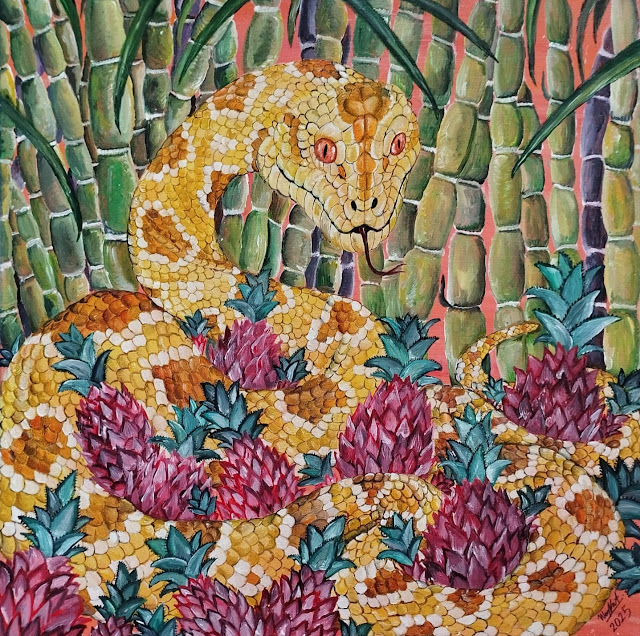
Elder Serpent's Blessing , acrylic on canvas, 2025. 24" X 24" The artist welcomes the Year of the Snake with this painting depicting an albino Burmese python with red pineapples and sugar cane. The albino Burmese python is chosen as the snake in the painting for its white and yellow scales, which make it look like it is gold in color. In Chinese culture, snakes are spiritual animals that represent wisdom, knowledge, good fortune, fertility, and longevity. According to ancient legends, the Snake has its own underground kingdom with numerous precious treasures, and those who are eager to make a great fortune should pray in the temple of the Snake. Red pineapples have become a modern symbol for prosperity and protection during the Chinese New Year and are favored for combining two ancient traditions into one decoration. The red pineapple is a rare cultivar that is believed to have originated in South America and is often grown as an ornamental plant.  The Chin...

ICONS OF THE RISING SUN (BOUNTY OF THE OCEAN)

Image
  Icons of the Rising Sun: Bounty of the Ocean , acrylic on canvas, 2024. 16.5" X 24" This 4-part series commemorates the 70th anniversary of Japan's beloved  Godzilla  franchise and fuses the fame of the so-called "King of the Monsters" with the popularity of Japanese culture. Both these icons have become extremely well-known worldwide.  Part 4 of the series focuses on the  Reiwa  era, which in the  Godzilla  franchise encompasses the mid-2010s to the present. The painting depicts Godzilla in its appearance from the Monsterverse, a series of American-made Godzilla films made in this era since 2014, which is an era of rapid spread of international popularity for the franchise. In the painting, Godzilla emerges from the ocean with fish jumping out of the water including tuna and saba /blue   mackerel. These fish, known for being key ingredients in seafood such as sushi , sashimi and grilled fish, are among those that made Japan known...

ICONS OF THE RISING SUN (HERO OF THE MILLENNIUM)

Image
Icons of the Rising Sun: Hero of the Millennium , acrylic on canvas, 2024. 16.5" X 24" This 4-part series commemorates the 70th anniversary of Japan's beloved  Godzilla  franchise and fuses the fame of the so-called "King of the Monsters" with the popularity of Japanese culture. Both these icons have become extremely well-known worldwide.  Part 3 of the series focuses on the  Millennium  era, which in the  Godzilla  franchise encompasses the late 1990s to the early 2000s. The painting depicts Godzilla in its appearance from the films Godzilla 2000: Millennium (1999) and Godzilla vs. Megaguirus (2000) where the monster is seen with purple spines. In the painting, Godzilla is seen alongside Mothra, a large moth monster that sometimes appears as either Godzilla's ally or adversary, which appears to sprinkle sakura (cherry blossom) petals on Godzilla to give its spines its pinkish hue.  Sakura plants are symbolic in Japanese culture, representing the...

ICONS OF THE RISING SUN (GUARDIAN OF TRADITION)

Image
  Icons of the Rising Sun: Guardian of Tradition , acrylic on canvas, 2024. 16.5" X 24" This 4-part series commemorates the 70th anniversary of Japan's beloved  Godzilla  franchise and fuses the fame of the so-called "King of the Monsters" with the popularity of Japanese culture. Both these icons have become extremely well-known worldwide. In 2015, the character Godzilla itself was granted citizenship and appointed as the tourism ambassador for Tokyo's Shinjuku district. Part 2 of the series focuses on the  Heisei  era, which in the  Godzilla  franchise encompasses the late 1980s to the early 1990s. In the painting, the 1985 version of Godzilla (as depicted in the film The Return of Godzilla ) is seen near a volcano that spews out gold "lava" and koban coins, the scene being a reference to the film's climax set near Mount Mihara, an active volcano on the Japanese isle of Izu Ōshima. The gold "lava" is also a reference to  kintsugi (go...

ICONS OF THE RISING SUN (POWER OF UMAMI)

Image
  Icons of the Rising Sun: Power of Umami , acrylic on canvas, 2024. 16.5" X 24" This 4-part series commemorates the 70th anniversary of Japan's beloved Godzilla franchise and fuses the fame of the so-called "King of the Monsters" with the popularity of Japanese food culture. Both these icons have become extremely well-known worldwide. Part 1 of the series focuses on the Showa era, which in the Godzilla franchise encompasses the 1950s to the 1970s. In the painting, the 1954 version of Godzilla is seen breathing out crystals of monosodium glutamate (MSG), a flavor enhancer which is marketed across the world under the brand name " Aji-no-Moto ". MSG is a popular condiment as it has a savory taste, or umami taste, which is regarded as the fifth basic taste; characteristic of broths and cooked meats. Foods that have a strong umami flavor include meat and seafood. Japan is known to have a food culture based around their extensive seafood industry. The abun...

WINTER'S JOY

Image
Winter's Joy , acrylic on canvas, 2024. 24" X 24" The painting depicts a fun scenery that incorporates elements of winter and the Christmas festivities, and intends to present Christmas as a time of joy and togetherness during winter. In the painting a family of snowmen gather near a gingerbread house and engage in various activities and put on various outfits, while another snowman (a reference to Frosty the Snowman) rides with a Christmas nutcracker and a gingerbread man on a sleigh pulled by a reindeer (a reference to Rudolph the Red-Nosed Reindeer). The jolly face of Santa Claus appears in place of the sun, similar to the baby-faced sun from the children's TV show,  Teletubbies .

MID-AUTUMN MOONGAZING

Image
  Mid-Autumn Moongazing , acrylic on canvas, 2024. 24" X 16.5" The artwork is made for the Mid-Autumn or Mooncake Festival and incorporates various elements related to the festival, including mooncakes, rabbits and lanterns, coming together to represent unity. The festival falls on the 15th day of the 8th month in the Chinese lunar calendar, when a full moon would be visible by night. The full moon in the night sky is a powerful symbol of unity, as it reminds people of the importance of family and loved ones coming together. Gazing at the full moon is a time-honored tradition during the festival, as it is believed to bring good luck and happiness to the family. The centerpiece of the Mid-Autumn Festival celebrations is the mooncake, which can come in various flavors ranging from red bean paste to green tea to charcoal durian. Representing the full moon, mooncakes are also potent symbols of unity, reunion and completeness. Lanterns are another essential element in the Mid-Autu...

FELINE FORTUNE

Image
  Feline Fortune , acrylic on canvas, 2024. 24" X 24" The Lucky Cat is a well-known symbol of good fortune displayed in restaurants, cafes, shops, and homes around the world, but especially popular in Chinese and Japanese culture. The main cat in the painting is gold, which is the color most closely associated with money and wealth. The Lucky Cat usually holds a Japanese koban coin with one paw while raising the other. In the painting the left paw is raised, which is to beckon or invite customers. The artist adds other big cats such as lions, tigers and leopards which are symbols of protection and strength, as well as other auspicious objects of Chinese culture such as a bottle gourd, a peach and a ruyi (ceremonial scepter). When accompanied by wealth-associated objects, the big cats are also a tremendous symbol of wealth.

LUCKY STREAK

Image
  Lucky Streak , acrylic on canvas, 2024. 20" X 20" The artist welcomes the Year of the Dragon with this painting depicting four young dragons playing a game of mahjong . The black dragon appears to have achieved a winning deck by drawing a 發財 " fa cai " (green dragon) tile, much to the shock of the white dragon sitting in its opposite direction, probably during a lucky streak. It implies a popular case of 食糊 (" sik wu ": winning off another player's discard), where the white dragon may have discarded the " fa cai " tile before it was drawn by the black dragon. The deck shown on the black dragon's side is shown to be "All in Triplets", where in the Hong Kong mahjong scoring rules, the player gets mostly combinations of 3 or 4 identical tile sets (碰 pung for 3 tiles, 杠 kong for 4). The dragons' winnings are shown as gold coins stored in money pots. The artist intended for the black dragon to achieve the winning deck as the bl...

CHILDREN OF THE DRAGON

Image
  Children of the Dragon , acrylic on canvas, 2024. 20" X 20" The artist welcomes the Year of the Dragon with a painting that depicts two mythological creatures which combine the aspects of the dragon with other animals. The qilin is sometimes referred to as the dragon horse. It is a fabulous creature of good omen, prosperity, success, longevity and enchantment. The qilin 's presence is said to attract the powerful cosmic breath of the dragon, thereby bringing good luck. It is also the symbol of the first rank military official. The  qilin  embodies all five elements and is often associated with the element of fire. The dragon tortoise combines the awesome powers and attributes of the dragon and the tortoise, two spiritually-endowed creatures in Chinese symbolism. While the tortoise symbolizes longevity, the dragon represents success, courage and determination. The dragon tortoise also signifies wealth when paired with gold coins or ingots. This mythical creature is ...

NINE DRAGONS: WEALTH AND PROSPERITY

Image
  Nine Dragons: Wealth and Prosperity , acrylic on canvas, 2023. 60" X 36" The artist welcomes the Year of the Dragon with this painting which depicts nine golden dragons and an abundance of wealth in the form of gold coins, gold sycees and red pearls. The painting seems to be inspired by the Nine Dragons painting by Chinese artist Chen Rong from 1244 (during the Song Dynasty). In Feng Shui philosophy, the dragon symbolizes prosperity and abundance. In Chinese culture, nine is the sacred number of the emperor. It was believed that the dragon king could change into nine dragon forms. The dragon in the center is supposed to represent the emperor (based on its pose), as traditionally, royal dragons have five toes or claws. The other eight dragons have four toes, and four-toed dragons are considered common and not part of the nobility. This conveys a message that wealth can be enjoyed, no matter the status, and that all classes can get along with each other in times of celebratio...

SHRINE OF HARMONY

Image
  Shrine of Harmony , acrylic on canvas, 2023. 24" X 16" The twelve animals of the Chinese zodiac symbolize the earthly branches. In order, they are the Rat, Ox, Tiger, Rabbit, Dragon, Snake, Horse, Goat, Monkey, Rooster, Dog, and Pig. Each of the twelve Chinese zodiac signs has a unique character that differentiates them from one another. Every individual is different to every other individual, as they attach themselves to factors (like race, religion, hobbies, etc.) which make these individuals appear similar although these things are shallow. Although some of the signs are conflicting with others (e.g. rat and horse, ox and goat, etc.) and may struggle to feel in sync with each other, building mutual respect and tolerance as well as accepting and appreciating differences in each other are vital for stability. Despite said differences, everyone is equal in their basic wish for peace and happiness. The painting is inspired by visits to Thean Hou Temple in ...

FRENCHISE

Image
Frenchise , acrylic on canvas, 2023. 18" X 26" The painting depicts several symbols which represent the country of France. The title of the painting is a combination of the words French and franchise (which can be simply explained as a recognizable business because their signs and colors are the same). The word franchise almost resembles the French word for French, Français . The Eiffel Tower in Paris is the most recognizable landmark and the tallest building in the French capital. Built from wrought iron in the late 1880s, it has since become a global cultural icon of France and one of the most famous structures in the world. The rose is a symbol of romance, and the pink rose in the painting is said to be the Rosa 'La France', a hybrid rose cultivar found in France in 1867. A pink rose is also a symbol of elegance and admiration. Three roses are in the painting, conveying that one would fall in love in the country's romantic atmosphere, and reflects Paris's n...

LUCKY PATCH

Image
  Lucky Patch , acrylic on canvas, 2023. 30" X 20" This artwork which combines several lucky symbols is made to celebrate the Year of the Rabbit in 2023.  Rabbits have been considered a symbol of fortune for over 2,000 years. In both Eastern and European cultures, rabbits have been associated with the spring season and fertility. Nine rabbits and hares are present in the painting, and nine is a lucky number which is symbolic of higher attainment, accomplishment, and success.  The Flemish Giant (background) is the largest breed of domestic rabbit in the world, weighing around 7-8 kilograms (15-18 lbs) and measuring around 80 centimeters long, while the Netherland Dwarf is one of the smallest rabbit breeds, with two in the painting being colored brown and grey.  Jackrabbits like the black-tailed jackrabbit (left) are hares because they have large, long ears, long legs, and a larger body than rabbits. The Arctic (middle right) and snowshoe hares (bottom left) live in co...

PROSPEROUS ABUNDANCE

Image
  Prosperous Abundance , acrylic on canvas, 2022. 18" X 24" An ancient Chinese tale tells of a huge school of Koi fish swimming upstream the Yellow River in China. Gaining strength by fighting against the current, the school swam through the river until they reached a waterfall at the end of the river. Many of the fish turned back, but the remaining Koi continued swimming against the waterfall and attempted to reach the top of the waterfall by leaping all the way. After a hundred years of jumping, one Koi finally reached the top of the waterfall, where it was noticed by the gods at the Dragon Gate for its perseverance and determination and they turned it into a golden dragon, the image of power and strength. According to Feng Shui, fish represents wealth and prosperity because the actual word in Chinese for fish (魚 yú) also translates to “abundance” (裕 yù).  Because of the dragon legend, Koi fish are known as symbols of strength and perseverance, as seen in their determin...