Posts

Showing posts with the label Elephants

JUNGLE JAMBOREE

Image
  Jungle Jamboree , acrylic on canvas, 2026. 36" X 48" This artwork continues a series beginning with Rafflesia's Garden , this time centering on another large flower from the Southeast Asian region: the titan flower ( Amorphophallus titanum ). Endemic to rainforests on the Indonesian island of Sumatra, this flower is the largest unbranched inflorescence (a group or cluster of flowers arranged on a main stem) in the plant kingdom. This close relative of the konjac plant can also grow up to 3m (9 feet) tall and boasts a powerful odour often compared to the stench of rotting flesh, which is most potent during peak bloom at night into the early morning. The unique scent of the large flowers actually had a purpose: they attract their own host of pollinators such as carrion beetles and flies from across long distances.  The blooming of the titan flower can be said to bloom for just 2-3 days once every two to three years, making it a very rare occurrence in quite...

STRIKING SIMILARITY

Image
  Striking Similarity , acrylic on canvas, 2024. 24" X 24" This artwork highlights similarities between two types of plants - bamboo and sugarcane, which were a favorite food for two types of animals: pandas and elephants, respectively. Bamboo and sugarcane have several striking similarities - as they are both tall, woody plants of the grass family with hollow stems. Due to the similarities the plants have, elephants can also eat bamboo while pandas are also able to dine on sugar cane, which means they share one thing in common although a river divides them in the painting. There is a bridge for the pandas to cross while the elephants would be able to cross the river. An elephant is even shown offering a sugar cane. The painting reflects that different people could share interests although the interests slightly differ.

8X8 COLLECTIONS 2024

Image
The artist prepares several 8" X 8" paintings in preparation for an exhibition, showcasing land and sea animals as well as dinosaurs. DENIZENS OF THE DEEP Denizens of the Deep: Humpback Whale , acrylic on canvas, 2021.  8" X 8" Denizens of the Deep: Octopus , acrylic on canvas, 2021.  8" X 8" Denizens of the Deep: Jellyfish , acrylic on canvas, 2021.  8" X 8" SAFARI SIGHTS Safari Sights: Lion , acrylic on canvas, 2021.  8" X 8" Safari Sights: Elephant , acrylic on canvas, 2021.  8" X 8" Safari Sights: Giraffe , acrylic on canvas, 2021.  8" X 8" PREHISTORIC POP ICONS Prehistoric Pop Icons: Brachiosaurus , acrylic on canvas, 2021.  8" X 8" Prehistoric Pop Icons:  Triceratops , acrylic on canvas, 2021.  8" X 8" Prehistoric Pop Icons: Tyrannosaurus Rex , acrylic on canvas, 2021.  8" X 8"

CROOKED JUNGLE

Image
  Crooked Jungle , acrylic on canvas, 2024. 24" X 24" A crooked man lives in a crooked wooden house in a jungle full of crooked trees and crooked animals. This painting is inspired by the rhyme " There Was a Crooked Man " and is dominated by crooked and bent designs. Crooked lines are employed to convey excitement, restlessness and/or anxiety, which is perhaps reflected by the chaotic situation in the painting. The situation may have caused the crooked man to get out of the house to investigate.

JUM-BONDING

Image
  Jum-Bonding , acrylic on canvas, 2023. 16" X 20" Whether human or elephant, mothers love their children. The painting illustrates the docile and noble side of a mother elephant, tending to her young just like a human mother does. Elephants may be the most protective moms on the planet, being exceedingly vigilant with her offspring as well as protecting her child from predators and even providing shade by standing over it. Elephant calves are raised in a matriarchal (female-led) society which focuses on protection and encouragement. The maternal bond between elephants and their calves is remarkably strong, and calves were raised by their mothers till they reach adulthood. Mother elephants regularly make affectionate contact with their calves, and they also display deep emotion. By watching the adults, the calves learn basic skills, including searching for water and which plants are suitable to eat and how to access them. Elephant moms are there every step of the way and they...

INTERSPECIES TEAMWORK

Image
  Interspecies Teamwork , acrylic on canvas, 2022. 24" X 24" This painting is inspired by a popular Chinese nursery rhyme about pulling carrots (拔萝卜) . In the painting, six animals help each other to pull a colossal carrot: a hamster, rat, rabbit, monkey, kangaroo and elephant, in a carrot patch. The animals are arranged according to their size, with the hamster, the smallest of the six animals, being the first to pull the carrot and is helped by larger animals in increasing size until the elephant, the largest and strongest of the group, which is placed at the very back.  The artist intends to convey the message of teamwork among different groups, and that many hands make light work, no matter how strong one is.

DIVERSE WILDLIFE

Image
  Diverse Wildlife , acrylic on canvas, 2022. 31.5" X 24" Malaysia is one of the world’s megadiverse countries. It is also ranked 12th in the world, according to the National Biodiversity Index, which is based on estimates of country richness of life and species endemism. The country is home to over 15,000 species of flowering plants, 1,500 species of terrestrial vertebrates and about 150,000 species of invertebrates. The hibiscus is the national flower of Malaysia. The  Hibiscus rosa-sinensis  species comes in a wide range of colors including red, orange, yellow, pink and even purple. The red-colored hibiscus is regarded as the national flower, as the color red represents courage and the five petals symbolize the five principles of the  Rukun Negara . In the painting, four hibiscus flowers are depicted in the colors featured on the Malaysian flag: red, white, blue and yellow. The tiger is Malaysia's national animal. Fewer than 150 wild tigers remain in Malaysia's fo...

GLOBAL GATHERING

Image
  Global Gathering , acrylic on canvas, 2022. 84” X 42” This painting is a sequel to G7: You Can Count on Us . It has the same concept of animal representations of countries gathering for a global meeting, but with major differences and additional animals. The new countries and their respective animals are: Brazil = Jaguar The national animal of Brazil is the jaguar, seated beside Canada's beaver in the painting. It wears a green and yellow costume with a badge depicting the blue, star-studded disc on Brazil's flag. Russia = Brown bear In geopolitical cartoons, Russia is usually represented by a bear. The bear in the painting wears a fur coat typically worn by Russians and had a badge with a Russian flag on it. China = Giant panda The giant panda is native to China and is a symbol of the country's wildlife. The panda in the painting wears a red and yellow outfit matching the Chinese flag's colors, complete with the flag's five stars on the right chest area. The pand...

THE WATERING HOLE

Image
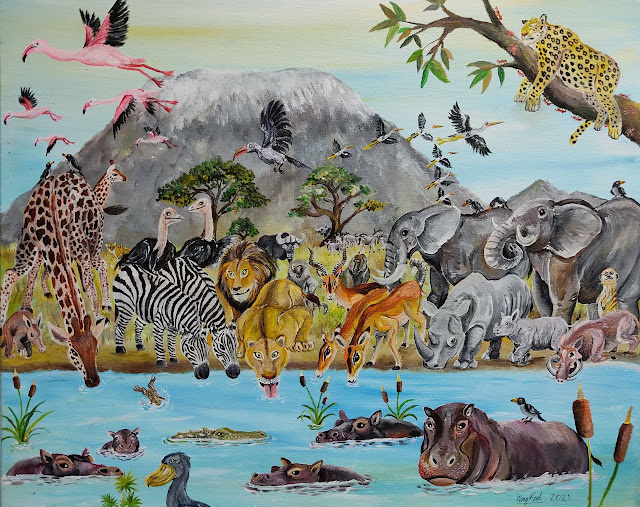
The Watering Hole,  acrylic on canvas, 2021. 30" X 24" The painting depicts a large group of African animals gathering to drink at a watering hole. The overall composition of the animals' activity in the painting is based on the idea of the "waterhole truce" put forward by author Rudyard Kipling (author of The Jungle Book ), where animals observe a sort of truce around watering holes and prey animals do not have to be on guard from predators in the vicinity, as they share the watering hole.  The African animals featured are elephants, giraffes, lions, zebra, rhinoceros, impala, ostriches, Cape buffalo, wildebeest, baboons, cheetah, leopard, warthog, meerkat, aardvark, hippos, crocodile, shoebill and red-billed hornbill. Flamingoes and storks frequent African waterholes as well. Giraffes spread their legs when drinking to increase their stability when lowering their head down. Predators like lions normally use watering holes as prey gathering sites before hunting...

G7: YOU CAN COUNT ON US [SOLD]

Image
  G7: You Can Count On Us , acrylic on canvas, 2021. 60" X 36" Production period: 23 June - 29 July 2021 INTRODUCTION This painting is loosely based on a satirical cartoon made by Chinese government-appointed propaganda cartoonist cartoonist Bantonglaoatang entitled "The Last G7", which is based on Leonardo da Vinci's "The Last Supper". The original cartoon's intention is to mock the organization's "malicious" attempt to rally its allies and lay a siege on China's global status, and it went viral on Chinese social media during the 47th annual Group of 7 (G7) summit which was held in June 2021 in Cornwall, UK.   Because the countries were represented by animals in the cartoon, the artist is inspired to jump in and apply his talent to paint a slightly changed version of the cartoon.  SYMBOLISM FROM THE ORIGINAL The countries are represented by the following animals (left to right): ⦁ Germany = Black hawk-eagle (changed to a black...

Art Block Collection: Tree Life

Image
 These paintings by the artist is part of a study based on trees and plants in his training journey. Rhinoceros Hornbill , acrylic on art block, 2018. 29.7 x 42 cm The rhinoceros hornbill ( Buceros rhinoceros ) is the state bird of Sarawak in Malaysia. Some Dayak people, especially the Ibans, believe it to be the supreme chief of birds and its statue is used to welcome the god of birds, Sengalang Burong , to the feasts and celebrations of humankind.  Bear, Hive and Tree , acrylic on art block, 2017. 29.7 x 42 cm Bears usually raid beehives in order to eat the pupae, larvae, and eggs in the brood comb of a hive. Although bears prefer immature bees, they also eat honey. Elephant and Tree , acrylic on art block, 2017. 29.7 x 42 cm An elephant trunk has up to 40,000 muscles, which can be divided into as many as 150,000 individual units. They can lift up to 770 pounds (350 kg) with their trunks. In the painting, an elephant uses its trunk to break a tr...

Collection: Majestic Menagerie V

Image
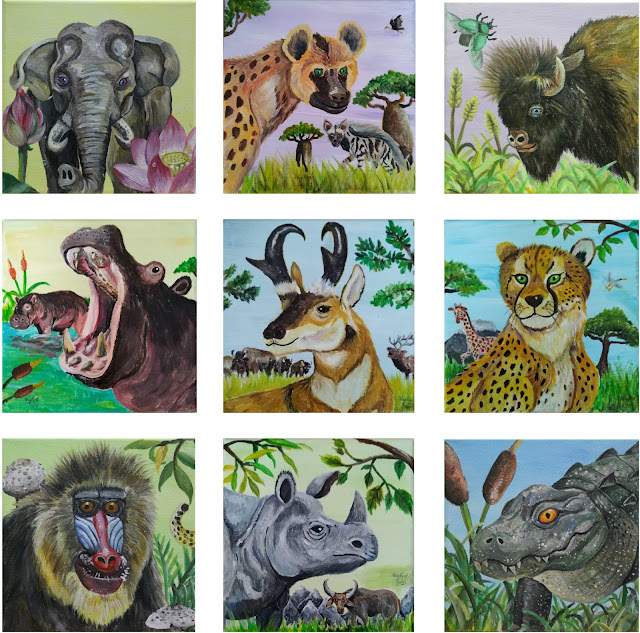
  MAJESTIC MENAGERIE V A menagerie can be defined as a collection of exotic and unique animals, and the term also refers to a precursor to modern zoos which also showcases exotic animals. In the 18th century, the term menagerie is used for animal collections by aristocrats or royals who seek to display their power and wealth because exotic animals are quite difficult to acquire and harder to maintain. The natural world, however, had a vast collection of diverse life which can be considered unique in their own ways. Majestic Menagerie Vol. 5 , acrylic on canvas, 2021. Set of 9, each piece 8" X 8"  Elephant Savanna Strongman , acrylic on canvas, 2021. There are two kinds of elephants today: the African elephant (pictured) and the Asian elephant. There are more than ten physical characteristics that differentiate Asian and African elephants, and the most important difference is that African elephants have larger ears than their Asian counterparts. Both male and female Africa...

Collection: Majestic Menagerie II

Image
MAJESTIC MENAGERIE II A menagerie can be defined as a collection of exotic and unique animals, and the term also refers to a precursor to modern zoos which also showcases exotic animals. In the 18th century, the term menagerie is used for animal collections by aristocrats or royals who seek to display their power and wealth because exotic animals are quite difficult to acquire and harder to maintain. The natural world, however, had a vast collection of diverse life which can be considered unique in their own ways. Majestic Menagerie Vol. 2 , acrylic on canvas, 2020. Set of 9, each piece 8" X 8"  American Alligator American Alligator, acrylic on canvas, 2020 The American alligator ( Alligator mississippiensis ) differs from most crocodilians in having a shorter, rounded snout and the teeth on the lower jaw being hidden when the animal’s mouth is closed. They inhabit swamps, streams, rivers, ponds, and lakes in the southeastern United States. Elephant Elephant and Lotus, acryli...